Sound Instruction
  • Home
  • What's New
  • The Basics of Sound
    • The Nature of Sound
    • Acoustics
    • Microphones
    • Loudspeakers >
      • Loudspeakers - Continued
    • Amplification
    • Understanding Alternating Current
    • Circuit Values
    • Amplifier Arrangements
    • Transistors
    • Interstage Coupling
    • Noise
    • Distortion Effects
    • Using an Oscilloscope
    • Frequency Response
    • Power Amplification
    • Phase Splitting Circuits
    • Audio Transformers
    • Distortion
    • Shielding
    • Cabling
    • Electro-Acoustics
    • Audio & Hearing
  • Microphone Types
  • Mic Placement
  • Gain Structure
  • Demystifying The Mixing Console
  • Equalization
  • Compression
  • The Ins & outs
  • The Sub Bus
  • The Voicing Concept
  • Reverb
  • Good Habits
  • Psychoacoustics
  • Stage Isolation & Drum Booths
  • System Feedback
  • System Noise & Hum
  • Electronic Repair
  • Speakers
  • Tips & Tricks
  • Noise Gates
  • Mixing 101 & Beyond
  • DIY Projects
  • Digital Audio Basics
  • Stage Lighting
    • Lighting Basics
    • Brightness
    • Color
    • Controls
    • Smoke
  • Books
    • Yamaha Sound Reinforcement Handbook
    • Sound Recording & Production
    • The Art of Record Production
    • Recording & Production of Sound
    • BBC - Microphones
    • Microphones - 3rd Edition
    • How To Build A Small Studio
    • Acoustic Techniques for Home & Studio
  • The Blog
  • References Page

Mixing Cleanly Series PT. 2 - Mute That Sucker

5/21/2015

1 Comment

 
Picture
Go ahead, make my day
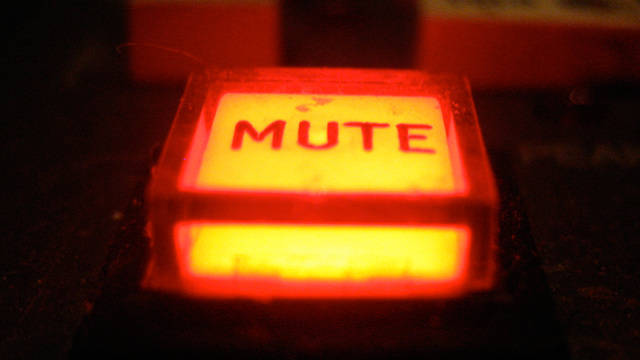
One of the most powerful tools in your mixing disposal, is the mute button.  I have had times when the band is killing it, and then there's some dude impersonating Henry Kaiser rocking a solo that sounds something like Yoko Ono getting in a fight with a bumble bee:
There are times when somebody in the band is just not paying attention and are off in La La Land, or sometimes you'll have somebody who is convinced that they should play as many notes as possible in a worship set.  This can leave you in a difficult situation because you don't want to be rude and mute them, but you know what...you totally should.  Go ahead.  No biggie.  They should learn the meaning of the term "tasteful."
One of the most effective uses of the mute button, are out-of-tune background vocals.  Have you ever had that situation where you have a "vocalist" that hears everything a half-step lower than the actual song? 

Mute Button.


How about the guy that is convinced he should try and play the new blues pentatonic scale "he just learned" throughout the entire song? 

Mute Button.
 

Or the same guy that just bought an e-bow, and decides he wants to use it during the entire worship set? 

Mute Button.


Worship Leader: "Hey guys, let's use drum loops for the first time this Sunday morning with a drummer that couldn't play to a click if their life depended on it."  That sounds like an excellent idea! 

Mute Button.


I think you may be getting the idea now.

Here's a technique developed by Courtney Love's engineer he has used countless times (I'm almost sure of it):  When there is something coming across the speakers that sounds like someone is torturing a possum with a cattle prod - you grab the fader and start bringing down the volume gently, but quickly...and then in one smooth act of mercy, you bring the other hand up to the console and press the Mute Button so that the audio of the offending channel doesn't cut off too suddenly. 

Aaaahhhh.  That's better!

1 Comment
harrywwc
5/21/2015 03:25:14 pm

as a sound-guy, and also guitarist who has (mute-d drumroll) an eBow ;) it is definitely an 'effect' that is very much an instance of "less is more" :) I think I've used it for one song, and only for parts of that song. I believe the electric/lead guitarist should most of the time "shut the heck up" and only fill in to add "flavour" to the song.
When working the desk, another lead guitarist just gives this constant flow of notes all through the song(s). So I just pull him back low during the singing, swell him up as needed in the breaks, and pull him back. Just this endless flow of notes flowing down the wire...
While note mute'd, certainly closer to -infinity than 0 on the fader :)

Reply

Your comment will be posted after it is approved.


Leave a Reply.


    Do you like vintage recording gear and articles?  You should visit our sister site: The Vintage Audio Portal!


    **Advertise With Us! We have thousands of visitors a day. Contact us here to learn more.

    Archives

    August 2021
    December 2019
    August 2019
    December 2018
    November 2017
    August 2017
    July 2017
    June 2017
    May 2017
    March 2017
    February 2017
    December 2016
    November 2016
    September 2016
    August 2016
    July 2016
    June 2016
    May 2016
    March 2016
    February 2016
    January 2016
    December 2015
    November 2015
    October 2015
    September 2015
    August 2015
    July 2015
    June 2015
    May 2015
    April 2015
    March 2015
    February 2015
    January 2015
    December 2014
    November 2014


    Categories

    All


Powered by Create your own unique website with customizable templates.
  • Home
  • What's New
  • The Basics of Sound
    • The Nature of Sound
    • Acoustics
    • Microphones
    • Loudspeakers >
      • Loudspeakers - Continued
    • Amplification
    • Understanding Alternating Current
    • Circuit Values
    • Amplifier Arrangements
    • Transistors
    • Interstage Coupling
    • Noise
    • Distortion Effects
    • Using an Oscilloscope
    • Frequency Response
    • Power Amplification
    • Phase Splitting Circuits
    • Audio Transformers
    • Distortion
    • Shielding
    • Cabling
    • Electro-Acoustics
    • Audio & Hearing
  • Microphone Types
  • Mic Placement
  • Gain Structure
  • Demystifying The Mixing Console
  • Equalization
  • Compression
  • The Ins & outs
  • The Sub Bus
  • The Voicing Concept
  • Reverb
  • Good Habits
  • Psychoacoustics
  • Stage Isolation & Drum Booths
  • System Feedback
  • System Noise & Hum
  • Electronic Repair
  • Speakers
  • Tips & Tricks
  • Noise Gates
  • Mixing 101 & Beyond
  • DIY Projects
  • Digital Audio Basics
  • Stage Lighting
    • Lighting Basics
    • Brightness
    • Color
    • Controls
    • Smoke
  • Books
    • Yamaha Sound Reinforcement Handbook
    • Sound Recording & Production
    • The Art of Record Production
    • Recording & Production of Sound
    • BBC - Microphones
    • Microphones - 3rd Edition
    • How To Build A Small Studio
    • Acoustic Techniques for Home & Studio
  • The Blog
  • References Page
